4.1 Introduction
 As a wedding planner, you will encounter couples of all kinds.
On average, you will find that couples start planning their wedding between 12 and 18 months before their wedding date. However, you may find that some couples take more or less time than this.
This module includes a basic guide to a general timeline for the wedding planning process over 18 months.
No. of Weddings Per Month
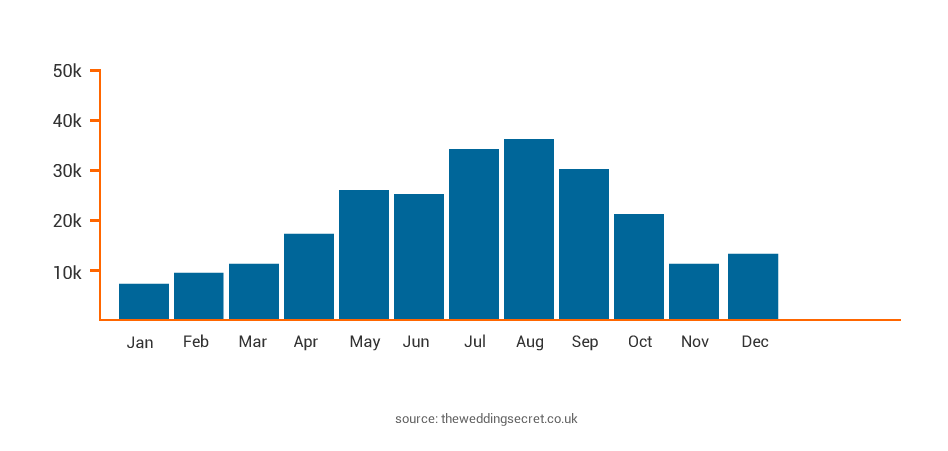
The graph above shows the average number of marriages per month in the UK. As you can see the summer months are the most popular, but don’t expect to be quiet during the winter as even in January there are still over 6,500 marriages taking place. Plus, with up to 18 months of preparation required for a wedding, there will be plenty to do in the “quieter” months.
4.2 Up to 18 Months Before the Wedding
The first few months of the wedding planning process will be crucial to the success of the final few months of preparations, even a year later.
Here are some things you will get up to during this time:Defining a Budget
A large part of your task as a wedding planner will be to help the couple establish, define and stick to a budget. This budget should be the first thing that you work on because it will set the precedent for the rest of the planning process.Preliminary Creative Process
Many couples will come to you with several ideas for themes and other creative components of their wedding. At this point in the process, you will be talking them through what is feasible on their budget.Set a Date and a Venue
It really is never too soon to set a date and a venue. The best venues in your local area will book up fast, so don’t be slow here.Book the Officiant
Whether it’s a humanist or the local Catholic priest, you also need to make sure the chosen officiant is available for the couple’s big day.Begin Researching Essential Service Providers
Look at photographers, caterers, florists, and designers who’ll meet the couple’s needs in terms of budget and style. Collect information on them and prepare to present it to the couple at a later date.4.3 Up to 12 Months Before the Wedding
Get the essentials booked
One year before the wedding, you need to have a date set for the wedding. This allows you to book two of the most important parts of the wedding: the venue and the officiant.
Research vendors
You will begin preliminary research for your vendors about a year in advance as well. You want extra time to make sure that the vendor is right for the job.
Hire a photographer and videographer
Although you don’t need to discuss the exact details of what’s needed on the day, now’s the time to book.
Arrange the entertainment
To successfully arrange the entertainment, you might want to attend the gigs of the people you’re looking at. In some cases, the couple might want to do this instead, or they may want to join you.
Begin looking at caterers
Now’s the time to start tasting samples, negotiating prices, and putting forward menus. At this stage, you need to ask the couple to check on the guests’ dietary requirements.
Purchase dresses
A bride’s body can change a lot between the time of the dress purchase and when she gets married. However, at this stage you need to start getting the perfect dress in mind.
Arrange accommodation for out of town guests
Some guests will be local; others will travel far and wide to attend a wedding. When negotiating for hotel rooms, ask for discounts for a block booking. This is easier at some times of year than others, but is expected as part of your role as a wedding planner.
Begin creating the gift registry
When creating the gift registry, don’t stick to just one retailer unless the bride and groom want you to. Choosing two or three is a great way to diversify and increases the chances that the guests can buy what the couple wants.
Consider setting up a wedding website
Not all couples want a wedding website. Some, however, will need consistent information about where to buy gifts, times, and what’s going to happen on the day.
4.4 One Year to Six Months Before the Wedding
During this time, you are far enough out from the wedding that things won’t be desperate.
But to make sure that you keep yourself on track, start talking about these things now.Discuss honeymoon plans
Some couples prefer to do this alone, but others may want your input in terms of organising and negotiating.Purchase bridesmaids’ dresses
By now, the bride will hopefully have an idea of the types of dresses she wants. She will also have a confirmed list of the women who have agreed to be bridesmaids in the wedding. Now is a good time to choose those bridesmaids’ dresses.Meet with the officiant
Officiants have held hundreds of weddings before, but, at the same time, they prefer knowing about the bride and groom’s unique situation. You won’t always be needed there, but encourage them to meet with the officiant.Start adding in logistical extras
From tables and chairs through to sashes and additional décor, the little extras can make a big difference. Begin reserving them, if the venue you’ve chosen doesn’t hire them out or provide them already.Arrange for florists and transport
Florists can work quickly, but that doesn’t mean you shouldn’t book them well in advance. In addition, transport can become unavailable quite rapidly during key times of the year.Start discussing what will happen on the day
All great weddings have a timeline. You need to begin planning everything from the moment the couple starts getting ready to the second the last guest leaves the venue.4.5 The Last Six Months
During this last period, the pace of the planning will begin to pick up.You will need to begin confirming all of your vendors. You will also need to begin tracking the RSVPs from wedding guests. You will also need to schedule wedding appointments, like beauty appointments.
Check on the invites
Has everyone RSVP’d? If not, start asking them why and chasing them up.
Book the cake
Great bakers will become busy during wedding seasons. Get the couple to decide on the type of cake they need and book that baker.
Make appointments for final clothing fittings
From the bride’s accessories and shoes through to the groom’s suit hire, those final clothing fittings will perfect the outfit and need to be arranged well in advance.
Schedule hair and makeup artists
You do not need to decide on the exact styles at this moment in time, but finding the right hair and makeup artist is essential. You will want to book appointments a few months in advance, especially if you are booking appointments for the whole wedding party.
Choosing music
Create a selection of songs according to the couple’s tastes; sit down with them and find those essential tunes for walking down the aisle, interludes, and other key moments.
Menus, flowers, and favours
By now, you need to know dietary requirements, flower arrangements, and the types of favours the couple wants. You should have narrowed down these items from preliminary ideas into workable suggestions to send on to your vendors.
Readings and toasts
Do you know who will be doing a reading? Would the couple like to schedule the reading timings? You may also want to look at having a toastmaster.
Give the event schedule to the vendors
Make sure the person you’re liaising with at the venue has a copy of the event schedule, and ensure all the key vendors have one too. If there are any hiccups, you’ll have lots of chances to resolve them.
Order rings
It is good to start ordering rings a few months in advance as well. This is especially true if the rings will be custom made or they will have special engravings added onto them.
Check on the vendors
Hopefully nothing will have gone wrong with the vendors in the space of a few short weeks. However, it’s your job to make sure everyone knows what he or she is doing, which means you should touch base with them.
Finalise the number of guests
Most people will have responded by now. However, you can’t count on final numbers and payments until you’re really sure.
Finalise song lists and entertainment
Along with the couple, you need to make sure the musicians and entertainment know what they can and cannot play, where they need to be, and how long they need to be there for.
4.6 One Month Before the Wedding
Attend final outfit fittings
Hopefully, the outfit fittings you have at this stage will be the last ones.Confirm times with everyone involved
Now’s a good time to cast your eye over expected arrival times. Make sure vendors know what they’re doing and where they need to be.Give out directions
From the buses transporting guests, through to the happy couple’s transport, you need to make sure everyone knows where to go.Begin assigning seating
Seating can be a bit of a contentious issue when it comes to weddings. However, it’s better to get it out of the way a month before rather than facing arguments on the day.4.7 The Week of the Wedding
By now, you should have confirmed everything from the menu to the flowers once.During the last week, you want to make sure that everyone is still good to go for the wedding.
Final vendor check
Yes, making all those vendor checks is frustrating – for everyone involved. However, it’s better than dealing with someone not turning up on the day.
Delegate tasks
Whether you have a team that you’re working with or you want to ensure the bridesmaids and ushers carry out their duties, this is the week to delegate tasks. Make sure that everyone knows what is expected of them so that the day can flow smoothly.
Make sure all parties have a copy of the timeline
The bridal party, groom party, and any other major party need to have a copy of the timeline so they know what’s going on. To get through the day without a bump, all necessary parties need to know where they need to be and when they need to be there.
Pick up the dress and finalise the photographer
Pick up the dress and make sure the photographer knows what they’re doing on the day.
Get the venue assembled
This will happen in the 24 hours before the day itself. Make sure everything is assembled and set up the way you want it to be.
Module Summary
This is a basic guide to the wedding planning timeline. Over the next few modules, you will learn more about the complexities of these individual tasks.[Tweet “I just completed Module 4 of the Wedding Planning Course”]